Portfolio

Here's the work.

One case study and two samples that show how I build hiring and training systems for clinical teams.

Case study · Fictional project

Insurers kept denying Harbor Lane's claims for the same reason: the notes did not show why care should continue.

Harbor Lane Behavioral Health is a fictional three-site outpatient agency. The denial reasons, baselines, and goals below are illustrative assumptions, not client data.

  • ClientHarbor Lane Behavioral Health (fictional)
  • AudienceNew providers in their first 30 days
  • What I built12-minute branching scenario and note-quality checklist

Try the scenario

Same session, two notes

A fictional client says she is “doing okay.” She has missed two work shifts this month and sleeps about four hours a night.

Weak note

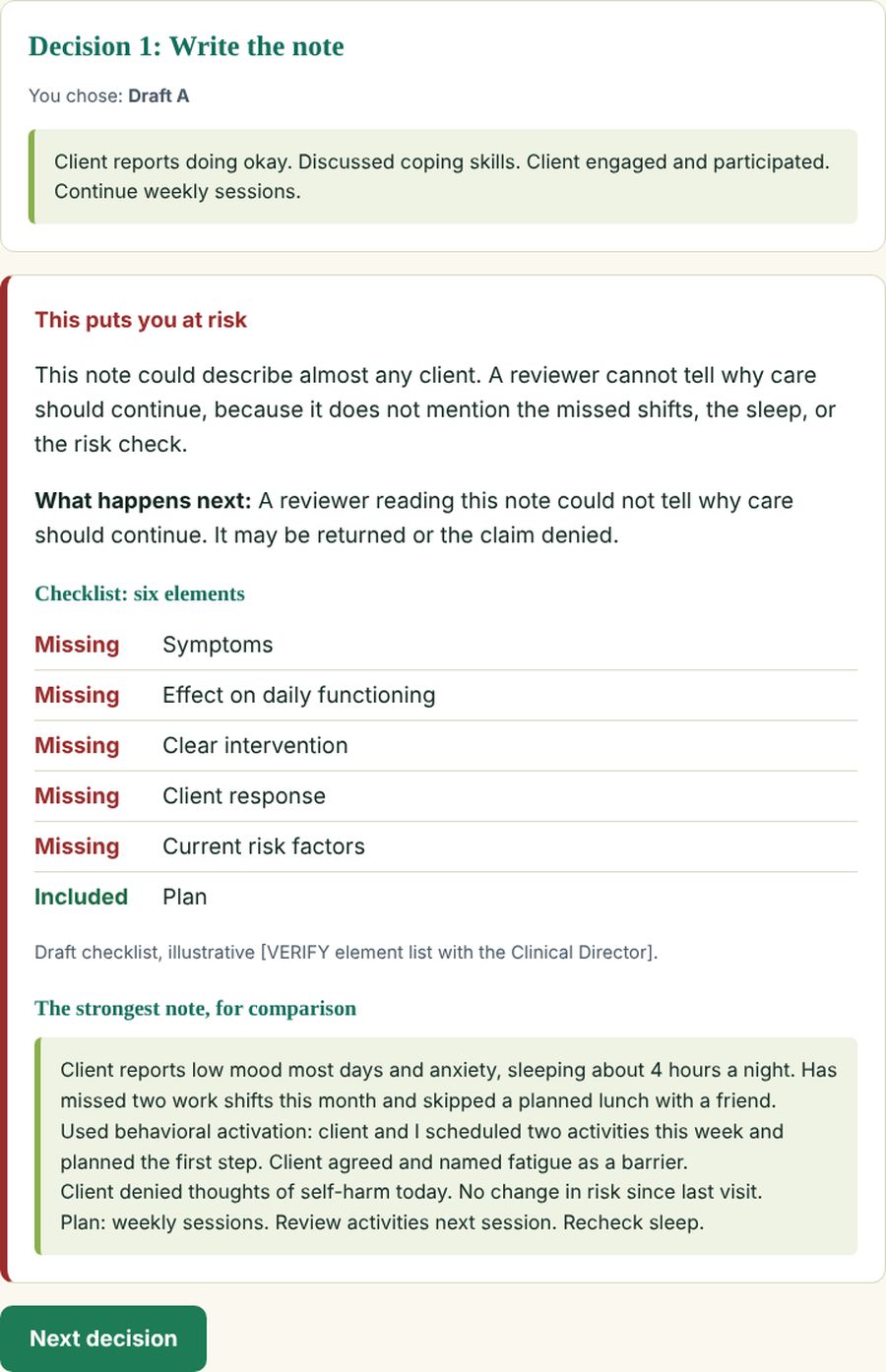
Client reports doing okay. Discussed coping skills. Client engaged and participated. Continue weekly sessions.

  • Missing Symptoms
  • Missing Effect on daily functioning
  • Missing Clear intervention
  • Missing Client response
  • Missing Current risk factors
  • Included Plan
Strong note

Client reports low mood most days and anxiety, sleeping about 4 hours a night. Has missed two work shifts this month and skipped a planned lunch with a friend.
Used behavioral activation: client and I scheduled two activities this week and planned the first step. Client agreed and named fatigue as a barrier.
Client denied thoughts of self-harm today. No change in risk since last visit.
Plan: weekly sessions. Review activities next session. Recheck sleep.

  • Included Symptoms
  • Included Effect on daily functioning
  • Included Clear intervention
  • Included Client response
  • Included Current risk factors
  • Included Plan
01 · Problem

Problem

Payers deny claims for insufficient clinical evidence, and auditors flag notes. Each denial costs billable revenue and supervisor time. New providers feel it most, and many fall behind on productivity in their first weeks.

Illustrative denial reasons, based on common payer rejections:

  • No link between symptoms and daily functioning
  • Unclear clinical interventions
  • No client response to the interventions
  • Current risk factors missing or out of date
  • Generic wording that could apply to any client
  • No plan, or a plan that does not follow from the note
02 · My Role

My Role

I was the instructional designer and the clinical subject matter expert. I owned the needs analysis, objectives, sample notes, scenario, and measurement plan.

Harbor Lane's Clinical Director confirmed clinical accuracy. Billing and compliance supplied denial reasons and audit findings.

03 · Process

Process

I started with baselines and a gap analysis, not a course.

  1. Set baselines for denials, audit findings, late notes, and week-four goal attainment.
  2. Pulled the top denial reasons from billing before writing any content.
  3. Compared strong and weak notes to set the standard.
  4. Sorted causes into skill, motivation, and environment or tools.

One decision. Based on the assumed causes, I did not build a time-management module for late notes. They came from caseload and no protected time, so training would not fix them. I recommended protected documentation time instead, and built training only for the skill gap: new providers did not know what a reviewer needs to see.

Which problems training can fix
ProblemLikely causeTraining fixes it?
Notes that do not support medical necessitySkill gapYes
Late or missing notesWorkload, no protected timePartly
Burnout and caseloadStaffing, schedulingNo

My recommendations, not findings: an EHR note template with payer prompts, supervisor note review in weeks 2 to 4, protected documentation time, and a phased caseload ramp-up.

04 · Solution

Solution

Objective. After the scenario, a new provider writes a progress note with six elements: symptoms, effect on daily functioning, a clear intervention, client response, current risk factors, and a plan. The note is scored against a checklist.

I built a 12-minute branching scenario for laptop or phone with three decisions:

  • Writing a note right after a session
  • Choosing which late note to finish first
  • Responding to a note returned for insufficient clinical evidence

Each choice gets immediate feedback. I paired it with a draft note-quality checklist built from common denial language. New providers and supervisors use the same checklist.

Screenshot of the scenario: Decision 1 with a weak note chosen, feedback explaining what is missing, and a six-element checklist.
Decision 1 feedback, with the strongest note shown for comparison.
05 · Results

Results

This is a design sample, so there are no results yet. Here is how I would measure it:

Measurement plan
LevelMeasureWhen
1. ReactionTwo-question survey after the scenarioAt completion
2. LearningShare who pick the strongest choice on the first tryAt completion
3. BehaviorNote-quality checklist score on real notesDays 30, 60, 90
4. ResultsDenials, audit findings, on-time notes, week-four goal attainment, early turnover90 days, then 6 months

I would compare the new cohort with the last one. A pilot at one site against a comparison site would be stronger.

06 · Reflection

Reflection

I would change four things:

  • Get the denial data first. Billing's top denial reasons come before any decision points.
  • Bring billing and compliance in earlier. They know what payers reject.
  • Test with 3 to 5 providers and one supervisor. I would check that the strong choices look strong and that it fits in 12 minutes.
  • Build the checklist from the payers' own language. Supervisors and providers then score against the same standard.

The documentation skill carries over to primary care and specialty clinics. For those clients, I would swap in a scenario built on a medical visit note.

AI process note. I directed the problem, audience, and scope. I edited all copy. Clinical content would be confirmed with a Clinical Director before real use.

Learning & Workforce Development

Try the interactive scenario

A 12-minute branching scenario for new providers. Three decisions about clinical notes, with feedback after each one. It shows how I build practice, not just content. The project is fictional: Harbor Lane Behavioral Health is an invented agency, and no client data is used.

Open the scenario in its own tab if it feels cramped on your screen.

One more piece you can look at

Talent Acquisition & Retention

Hiring process map

A seven-stage map from job posting to the 90-day check-in. It shows where providers are commonly lost at each stage, what a strong version looks like, and who owns it. It also lists the skills that matter for seven common roles in behavioral health and clinics.

  1. Job posting
  2. Screening
  3. Interview
  4. Offer
  5. Credentialing
  6. Onboarding
  7. 30/60/90-day check-ins
View the full map

Not sure where your providers are slipping?

Answer 12 questions and see whether hiring, onboarding, training, or retention is costing you providers.

Take the Hire-to-Keep Scorecard Book a free 30-minute discovery call